Why a Game Turn Needs a Clear Beginning and End
Clear turn boundaries help players see who acts, what remains and when responsibility passes, keeping a tabletop game moving without repeated questions.
The most common mistake in turn-based game design is leaving the handover implicit: one player finishes an action, but nobody can tell whether the next person should begin. That ambiguity costs the table its rhythm, inviting pauses, repeated questions and accidental interruptions. Clear turn boundaries make a shared sequence legible without turning every move into an announcement.
Give the turn a recognisable starting cue
A turn needs a visible point of entry. That might be a marker moving to the next seat, a card drawn from a shared deck or a player taking a named role token. The cue should be easy to notice and difficult to confuse with an action that happens halfway through the turn.
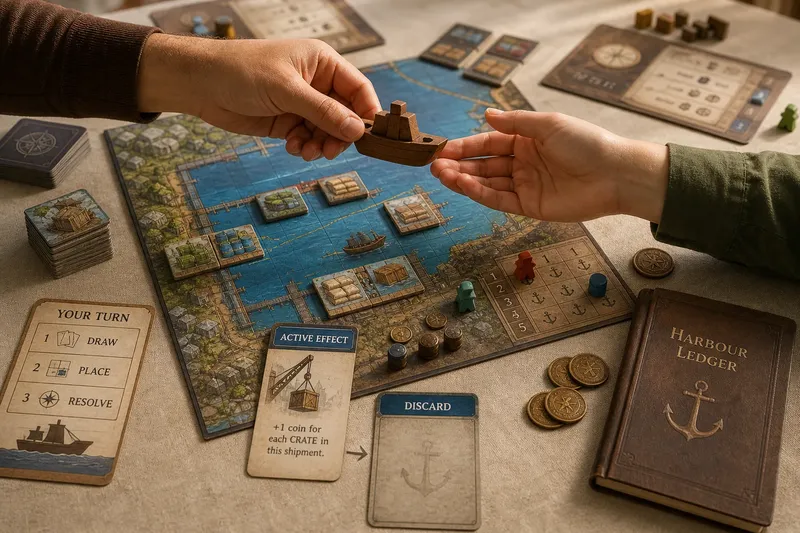
Consider a fictional tabletop game called Harbour Ledger. Players place cargo tiles, and a small wooden ship sits beside whoever is active. When a player completes their turn, they pass the ship clockwise; its arrival tells the next player that the sequence has reached them. No one needs to infer the handover from a pause or a change in conversation.
The cue can be tactile as well as visual. A token that changes hands gives its new holder a clear signal, while a shared board indicator may work better when players sit around a broad table. What matters is consistency: the same cue should mark the start throughout the round.
Make the allowed actions easy to scan
Players follow turns more readily when they can tell what belongs inside one. A compact sequence—draw, place, resolve—can be printed on a player aid or shown on the board. Each action then has a place, and players can see what remains without memorising a paragraph of rules.
Keep the order visible, but avoid crowding the playing area with reminders for every edge case. A short sequence is useful because it answers the immediate question, “What can I do now?” Detailed exceptions can live in the rulebook, ready for the moment they matter. If the core turn is hard to summarise, that may signal that several different procedures have been bundled together.
In Harbour Ledger, the active player draws one tile, places it beside a matching harbour, then checks whether that placement completes a shipment. The sequence gives the table a shared expectation: a player who has placed a tile still has one clear resolution to handle before passing the ship.
Show when an action is still resolving
Not every action ends the moment a player performs it. A card may trigger a shared effect, a marker may need updating or other players may need to respond. If that interval is invisible, someone can begin the next turn while the current one is still unfinished.
Use a distinct, simple signal for pending resolution. A card placed face up in a marked space, for instance, can mean “this effect is still active”. When the effect is settled, moving the card to a discard pile makes the transition visible. The signal should distinguish an unresolved effect from a completed action, rather than adding another symbol players must guess at.
Say a fictional player in Harbour Ledger places the final tile needed for a shipment. The board requires them to move the shipment marker before passing the ship; that marker move is the visible sign that scoring has been handled. The expected result is that the next player can begin with the previous turn visibly complete, not with an unresolved question hanging over the table.
Mark the end as clearly as the beginning
A turn should not end merely because its player stops speaking. Give completion a small, repeatable action: pass the active token, lower a turn marker or announce a short closing phrase if the game already uses spoken cues. A physical handover often carries more weight than a verbal cue alone, especially when players are concentrating on the board.
Make sure the ending cue happens after required effects, not before them. Otherwise the marker may say the next player is active while the current player still has a decision to resolve. A well-timed end cue closes the turn and hands responsibility over in one gesture.
In Harbour Ledger, the player passes the ship only after placing the tile, resolving any shipment and clearing any temporary effect. The order is plain enough to follow from the table, and the next player does not need to ask whether anything remains.
Keep turn boundaries fair across the table
Visibility is also a matter of equal access. A cue placed only on one side of a board can disappear behind cards, hands or a tall player aid. Put shared indicators where people can see them from their seats, and choose shapes or labels that remain distinguishable when colours are hard to tell apart.
Listen for the moments when players ask whose turn it is, whether an effect has finished or if they may act now. Those questions point to a boundary that the game is asking players to reconstruct from memory. A clearer token, board space or sequence aid may solve the problem more cleanly than adding another verbal rule.
It is not worth the effort to animate every transition with extra sounds, decorative lights or a separate marker for each tiny sub-action. Those flourishes can compete with the meaningful cues. Keep the signal simple enough that a player can spot it while watching the game, not studying the interface.
Answers to common questions about turn boundaries
Does every game need a turn marker?
No. A marker helps when several players share a sequence or when the active role is not obvious from the board state. In a simple game where the next player is unmistakable, a consistent handover may be enough.
Should players announce the end of a turn?
A brief announcement can support a physical cue, but it should not be the only sign if the table is noisy or players are focused elsewhere. A passed token or changed board indicator gives the group something visible to follow.
How can a game handle effects that continue after a turn?
Give continuing effects a clear home on the table, such as a designated space for active cards or a marker beside the affected player. That keeps the turn boundary intact while showing that an effect remains in play.
What makes a turn sequence too complicated?
If players regularly need to consult several rule passages just to identify the next ordinary action, the sequence may be carrying too many procedures at once. Separate the core turn from occasional exceptions, then make the core order visible.
For a designer refining turn boundaries, ask whether a player can glance at the table and tell who acts, what remains and when responsibility passes. A clear beginning and end let the game’s shared sequence speak for itself, leaving conversation for the choices that make play interesting.