A Film Casino Is Built for the Camera
Learn how to read a film casino through framing, sound and set details, so you can see how each choice guides attention and serves the scene.
The most common mistake in reading a film casino is treating it as a venue with a plot happening inside; that can obscure how each visible detail steers attention. A film casino is built for the camera: its doors, tables, lights and noise shape what the audience notices, rather than simply recording a neutral place.
Instead of asking only whether the room looks realistic, ask what the scene makes visible and what it leaves outside the frame. That shift turns a familiar setting into a readable design.
Start with the scene’s immediate pressure
A casino can become a meeting place, a maze, a stage for risk or a public arena where characters watch one another. Its role may change within a single scene: a wide shot establishes an exposed crowd, then a close view of a hand or face narrows the contest to a private exchange.
Identify what a character is trying to do. Are they blending in, attracting notice, waiting for an opening or hiding a reaction? That pressure helps explain why the camera settles on a doorway, roulette wheel or apparently unremarkable figure. A chandelier, for instance, may matter less as a sign of luxury than as a source of light that catches a character’s pause.
Use framing to see who has room to act
A broad view can make someone seem small among tables and moving bodies; a tight frame can make the casino disappear until only two people seem to exist. Neither image tells you the actual size of the set. Each shows how much social space the character occupies at that moment.
Entrances, exits and reflections can carry the same meaning. A camera lingering on an empty doorway keeps an absence in view; a mirror that catches someone outside the main action can suggest surveillance. Foreground figures may also block a table or shield a meeting. Ask what the composition reveals, conceals or makes difficult to reach, rather than cataloguing every corner.
Listen for the sounds the scene brings forward
A wash of conversation can suggest a populated room, while a burst of applause or a bell can give one moment extra weight. The useful clue is often when a sound rises above the general ambience.
If the background noise softens as a character concentrates, the shift draws the audience towards a decision or withheld response. A sudden quiet spell can work as a dramatic pause, even if it would be unusual in a crowded venue; the return of room noise may mark the end of that private moment.
Follow details that change the action
A uniform, chip stack, velvet rope or patterned carpet can establish a setting quickly, then do another job. The rope may divide visitors from insiders; a uniform may mark authority; a repeating carpet pattern may make a corridor feel disorientating.
Look for objects the camera revisits, characters touch or avoid, or the scene sets against its mood. A mirrored wall might first read as décor, then complicate who is watching whom. It is not worth listing every lamp and emblem: if an object receives no emphasis and affects no action, it may simply provide texture.
Separate realism from dramatic convenience
A fictional casino may leave out staff routines, waiting and ordinary transactions. Those omissions are not automatically errors; they can keep attention on a reveal or an exchange. Conversely, an unusually clear sightline or a sharply lit patch may help a character spot someone across the room or make a face legible.
For each detail, distinguish what looks plausible, what is convenient for the camera and what carries dramatic meaning. One table can do all three jobs: it may feel familiar, give the scene a recognisable setting and sit in a pool of light that turns it into a stage.
What questions help you read a film casino?
What should I watch first in a casino scene?
Start with what the characters are trying to accomplish, then notice what the camera makes easy or difficult to see. This keeps the setting connected to the scene’s pressure.
Why does a film casino sound quieter than a real one?
The soundtrack may lower general room noise so dialogue, a pause or a small signal remains clear. Treat that as a storytelling choice, not a guide to the sound of an operating venue.
Do film casinos need to look realistic?
They need to make the scene understandable and credible on its own terms, which may call for selective realism rather than a complete record. A simplified room can work if its layout and details support the action.
How can I tell whether a prop matters?
Look for a repeated shot, a character’s gesture, a conspicuous position or a change in sound around the object. If none appears and the object affects no action, it may be background texture.
Read one short moment from frame to sound
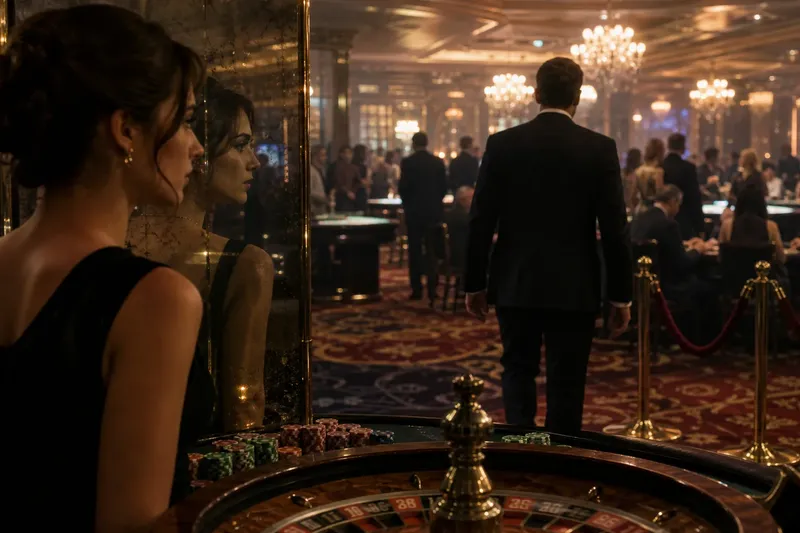
Say you encounter an invented scene in which a woman waits beside a roulette table while a man crosses the room. The camera first holds a wide view, then cuts to her reflection in a mirrored pillar; meanwhile, the rolling clatter grows clearer and nearby conversation softens.
Take the choices in sequence: the wide view establishes distance, the reflection makes her watchfulness visible, and the sound shift singles out the man’s approach. The resulting reading is that the scene builds anticipation without showing what she will do next.
Suppose the scene shows neither a close view of the game nor a staff member interrupting the exchange. Those omissions keep the focus on her wait, not the table’s operation. If the film returns to the mirror, it gains new significance; if not, it may have served only to clarify her position. That distinction is a useful way to read a film casino built for the camera: follow what the scene emphasises, and let unattended details remain in the background.