How Casino Lobbies Became Part of the Visit
Casino lobby history reveals how hotel entrances connected gaming with check-in, dining and entertainment, and how to separate a building’s original plan from later change.
The common mistake in casino lobby history is to treat the entrance as a decorative pause before the gaming floor. That costs us a clearer account of how hotel-casinos organised arrival, lodging and other guest services. Casino lobby history is easier to understand when each entrance is tied to its building and period, rather than treated as part of a single design story.
Atlantic City and Las Vegas make useful comparisons, but their development took place in different settings. Atlantic City’s casino era brought gaming into a seaside city’s existing hotel landscape, while Las Vegas developed its own hotel-casino tradition alongside tourism and entertainment. Neither city provides a template for every other venue.
Atlantic City placed casino arrival within a seaside hotel landscape
When Resorts International opened in Atlantic City in 1978, it used the former Chalfonte-Haddon Hall hotel complex on the Boardwalk. That setting connected casino play with an established lodging property and the city’s seaside visitor trade. The project’s particular building matters: its history cannot stand in for every entrance or hotel in Atlantic City.
Later properties were built or adapted as casino hotels, each shaped by its site and plan. A guest arriving from the Boardwalk, a car park or a hotel entrance could encounter different routes and first impressions. Those approaches reveal how a specific property handled access; they do not establish one standard lobby design for the city.
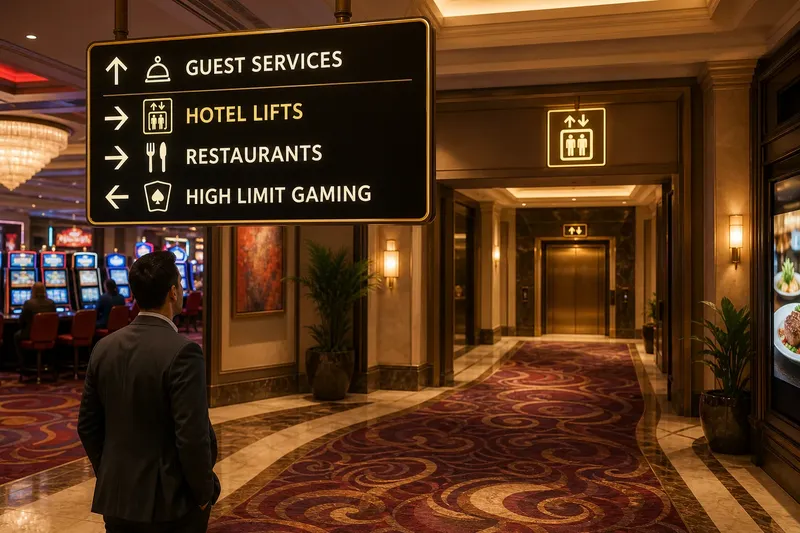
The hotel-casino made arrival part of a visit with overlapping purposes. Someone might be checking in, meeting companions, heading to dinner or going to play, and the entrance had to serve the building’s combination of uses. The balance varied from property to property.
Las Vegas lobbies belonged to a distinct resort tradition
Las Vegas had an established hotel-casino history before Atlantic City’s casino era began. The Flamingo, which opened in 1946, belongs to that city’s own development, as do later properties shaped by changing approaches to resort building and entertainment. These landmarks do not form a simple ladder from plain gaming hall to all-purpose destination.
Within a resort, a lobby might connect hotel registration with restaurants, shows, pools and gaming. Its position and character depended on the individual building: one entrance might emphasise reception, another might serve as a passage between public rooms. Plans and dated descriptions can clarify those choices better than a broad claim about what casino lobbies became.
Comparison works best at the level of named properties and documented features. Atlantic City’s Boardwalk buildings and Las Vegas resort properties had different local contexts, while both could bring lodging, gaming and hospitality together. That shared arrangement does not erase their separate histories.
What can a casino lobby tell us about its period?
Did the casino lobby begin as a separate room?
There is no single origin or standard plan for casino entrances. Their shape depended on the building, local rules, circulation needs and the relationship between gaming rooms and other facilities.
Why did hotel-casinos need more than a gaming entrance?
A hotel-casino also received guests checking in, visitors meeting others and people bound for dining or entertainment. The entrance had to work within those overlapping uses, although the emphasis differed by property.
Can Atlantic City and Las Vegas be treated as the same history?
No. Their casino development took place in distinct local and architectural contexts, and their buildings should be understood individually. Comparing them is useful when it clarifies a difference or a specific shared feature, not when it implies one common sequence.
What evidence helps date a lobby’s design?
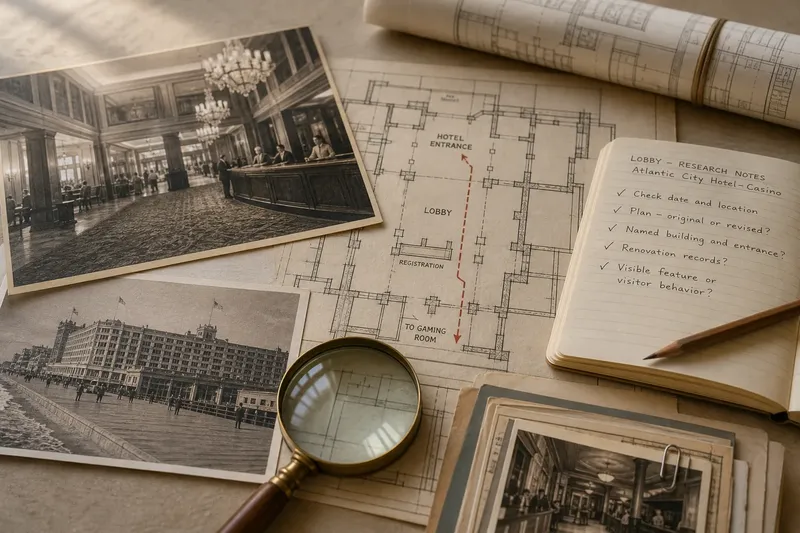
Architectural plans, dated photographs, building records and contemporary descriptions can help establish what a lobby looked like and how it was used. A later renovation may have changed the space, so a building’s opening date alone does not establish the appearance of its entrance.
Separate visible evidence from design interpretation
A photograph can show a reception desk, a doorway or a line of sight, but it cannot by itself explain why the designer chose that arrangement. Pairing images with plans, renovation records and contemporary accounts helps distinguish what is visible from what is inferred. Where the record is thin, describe the feature rather than claiming a broad change in guest behaviour.
Say a researcher has a dated photograph of an Atlantic City hotel entrance and a later plan for the same property. The photograph shows a reception counter and a doorway beyond it; the plan labels hotel access and a route towards gaming. The researcher can describe how those routes relate in each source, while noting that the photograph and plan show different phases rather than asserting how every guest moved through the building.
For a remodelled building, the present lobby may offer little direct evidence of its original arrangement. Check whether the photograph, plan or written description belongs to the period in question. If sources conflict, describe the discrepancy and consider whether it reflects renovation, changed use or an incomplete record.
What is not worth the effort is treating every decorative detail as a coded historical message. A chandelier or stone floor may establish a visual impression, but without supporting evidence it cannot explain a venue’s whole business strategy. Documented layout, access and use make firmer ground.
Check each source before making a historical claim
- Check the photograph’s date and location. If both are clear, use it for that specific setting; if either is uncertain, describe what appears without assigning it to a precise period or property.
- Check whether a floor plan is original or revised. If its date matches the period discussed, use it to describe routes; if not, treat it as evidence of the later layout and seek a period source.
- Check whether a source names the building and entrance. If it does, connect the description to that property; if it does not, avoid using it to characterise an entire city.
- Check for records of renovation. If they identify a change, distinguish the earlier and later arrangements; if the history is unclear, say that the current space may not preserve the original design.
- Check whether a claim concerns a visible feature or visitor behaviour. If a source documents the feature, describe it; if it does not document behaviour, present that interpretation as a possibility or leave it out.
- Check whether a comparison identifies both local contexts. If it does, explain the particular difference; if it treats Atlantic City and Las Vegas as interchangeable, narrow the claim to the property supported by the evidence.
The entrance makes most sense in its building’s history
Casino lobby history is not a story of one threshold gradually turning into a universal destination. Atlantic City’s casino hotels and Las Vegas’s resort properties show how entrances responded to particular buildings, local circumstances and combinations of guest services. A lobby becomes most revealing when its history is tied to a named place and supported by evidence about that place.
For casino lobby history, distinguish a building’s opening from the date of its present interior. A property may keep its name while its entrance changes, and a photograph may capture only one phase. Keeping those dates separate helps readers understand a lobby as a changing space with a specific record, not a timeless symbol.